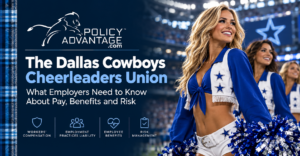
On October 23, the Dallas Cowboys agreed to recognize the Dallas Cowboys Cheerleaders Association as the collective bargaining representative of their cheer squad. The two sides are set to begin negotiating. The move puts pay, injury protection and workplace standards for professional performers on a formal bargaining agenda. It is worth understanding even if your organization has never employed a dancer.
The story reached the public through Netflix’s America’s Sweethearts. In the second season, veteran cheerleader Megan McElaney said a group of veterans had approached team officials about new contracts. The result, she said, was a 400% pay increase she called life-changing. The Cowboys did not disclose the amount, but said they were pleased the cheerleaders were happy with the outcome.
A year later, the conversation has moved from pay rates to a union. For employers, the squad is a compact case study in questions every organization faces: who counts as an employee, what counts as paid time, who pays when someone is hurt, and what happens when a complaint becomes a claim.
This article covers what is publicly known, what similar disputes show, and what employers and their advisors may want to consider. Where we look ahead, we say so. Nothing has been announced about what the union will ask for or what a first contract will contain.
✅ What Is Confirmed So Far
Three facts are on the public record as of this writing:
- The Cowboys recognized the Dallas Cowboys Cheerleaders Association (DCCA) as the squad’s collective bargaining representative, according to a joint statement from both sides reported by ESPN.
- The team recognized the union after what the release called “meaningful discussion,” and the parties are set to begin collective bargaining.
- Bargaining terms, timelines and demands have not been made public.
Until bargaining begins, anything beyond these points is analysis, which is why the rest of this article separates what is reported from what is considered.
⚖️ A Decade of Wage Disputes Sets the Backdrop
The Cowboys are not the first NFL franchise to face questions about cheerleader pay, and earlier cases show how costly those questions can become. Between 2014 and 2016, cheerleaders for five NFL teams filed wage lawsuits. Four settled for a combined total of more than $2.6 million.
| Team | Outcome | Reported amount |
|---|---|---|
| Oakland Raiders | Settled in September 2014 with 90 former cheerleaders | $1.25 million |
| Tampa Bay Buccaneers | Settled in March 2015 | $825,000 |
| New York Jets | Class action settlement approved January 2016 for 52 cheerleaders | $325,000 |
| Cincinnati Bengals | Settled in late 2015 | $255,000 |
| Buffalo Bills | Cheerleading squad (the Jills) disbanded after the suits were filed | Not reported |
The complaints followed a consistent pattern. Plaintiffs alleged that fees paid per game, spread across rehearsals, appearances and travel, worked out to less than minimum wage. In the Jets case, the lawsuit said cheerleaders received $150 per game and no pay for weekly rehearsals. The Jets said in their settlement that they admitted no liability.
Three takeaways stand out:
- Pay per event is not pay per hour. Courts and plaintiffs’ lawyers look at total hours worked, including rehearsal and travel.
- The consequences were structural, not just financial. The Raiders began paying minimum wage. In 2015, California passed a law requiring professional sports teams to treat cheerleaders as employees and pay them for practices and appearances.
- Dallas has been part of the conversation. A former Cowboys cheerleader named Wilkins, who cheered from 2014 to 2017, alleged in a lawsuit that she sometimes made less than minimum wage and was paid less than the team’s mascot. In September 2019, news outlets reported that the Cowboys had agreed to raise pay for the whole squad after the dispute. Reported changes included game-day pay rising from $200 to $400 and hourly pay from $8 to $12, which one outlet described as the practice rate. The coverage we reviewed did not detail settlement terms. Those changes came years before the 400% increase described in 2025.
The Buffalo Jills were the first NFL cheerleading squad to unionize, in 1995, according to NBC Sports. The squad disbanded in 2014 after a lawsuit alleging violations of New York’s minimum-wage laws. The 19th reported that the Jills are the only other NFL squad known to have tried unionizing.
The Buffalo effort and the Dallas development are separate events. We found no public account of how the Jills’ 1995 union was formed or recognized, so we do not compare the two processes. What is documented in Dallas is that the team voluntarily recognized the DCCA on October 23 and that the parties are set to begin collective bargaining. The Buffalo history shows how rare this step has been in the NFL. It is context, not a preview of what happens next.
🏷️ Employee or Contractor? Classification Drives Everything Else
Every insurance and benefits question starts with a more basic one: is the worker an employee? In the earlier lawsuits, teams defended low pay by labeling cheerleaders independent contractors. CNN reported at the time that courts had not accepted that distinction. Fortune reported a different wrinkle: a March 2014 Labor Department determination that the Raiderettes were seasonal employees exempt from federal minimum wage rules. The Raiders and other teams settled anyway.
Classification often drives the answers to these questions, though the details vary by law and by purpose:
- Whether minimum wage and overtime rules apply
- Whether workers’ compensation applies to an injury, which depends on the applicable state’s law and its test for employment status
- Whether the worker is eligible for unemployment insurance and employer-sponsored benefits
- Whether the worker has the legal right to organize and bargain collectively under the National Labor Relations Act, which covers employees and not independent contractors
Two cautions apply. First, the label on a contract is not conclusive. Tests for employment status look at the circumstances of the work, and they differ by state and by statute. Second, classification for one legal purpose does not necessarily settle every other issue, so a worker treated as an employee under one law may be analyzed differently under another.
Union recognition adds a legal layer. An employer may lawfully recognize a union based on evidence that most employees in an appropriate bargaining unit want representation, without an election supervised by the National Labor Relations Board. Once it does, it must bargain in good faith toward a contract, according to the NLRB’s own notice form.
Public announcements do not say how the Cowboys classify the squad for payroll, benefits or insurance. That is a fact to confirm, not assume.
🩹 Workers’ Compensation: The Injury Question, and a Texas Twist
Professional cheerleading is physical work. Performers rehearse choreography, perform on game days and travel to appearances. Workers’ compensation is the insurance built for this situation. It pays medical costs and part of lost wages for work-related injuries, regardless of fault.
We found no public data on cheerleader injury rates or claims, so we cannot say how often injuries occur on the Cowboys squad or any other. The risk is real enough that coverage should be a deliberate decision, not an afterthought.
Texas adds an unusual layer. It is the only state that lets most private employers opt out of the state workers’ compensation system. Employers that opt out are called nonsubscribers, and the trade-offs are significant:
- Nonsubscribers are not required to provide workers’ compensation benefits, though many offer their own injury benefit plan.
- They lose the legal protection the system normally provides, so an injured employee may be able to sue them directly.
- A Texas Department of Insurance report found that 22% of private year-round employers in the state were nonsubscribers in 2016, down from 33% in 2014.
We found no reporting on whether the Cowboys carry traditional workers’ compensation for the squad, so we make no claim either way. For any Texas employer with performers or part-time staff, the question is: which system covers an injured worker, and was that choice made on purpose?
What to consider. A first contract might spell out how rehearsal, appearance and travel time are treated for coverage purposes, and what happens when a performer is hurt away from the field. These are considerations, not predictions.
🛡️ Employment Practices Liability: Where Wage Claims and EPLI Meet
Employment practices liability insurance (EPLI) protects an employer against claims from employees who allege problems with how they were treated at work. Covered allegations typically include wrongful termination, discrimination, harassment and retaliation. Policy terms vary, so the wording matters more than the label.
The earlier NFL cheerleader lawsuits show why. Beyond low pay, plaintiffs raised a wider set of workplace-practice allegations. Former Raiderettes alleged fines for things like forgetting pom-poms or gaining weight, and out-of-pocket costs for hair and tanning, according to Mother Jones. Former Buffalo Jills alleged unlawful deductions, unreimbursed business expenses and late pay, according to CBS Sports. These are allegations, not findings. They show how one dispute can combine wage, expense and conduct issues.
Two cautions for any employer reviewing its own policy:
- Wage-and-hour coverage varies substantially by policy. Some EPLI policies exclude these claims entirely. Others may offer defense-cost coverage only, often subject to a separate sublimit and other conditions. Do not assume a standard EPLI policy will respond to a wage-and-hour dispute. Confirm what yours says before a dispute, not after.
- Coverage does not replace compliance. Insurance responds to claims. It does not fix a pay structure that creates them.
A union adds a new dimension. Collective bargaining agreements typically include grievance procedures, which can change how workplace complaints are raised and resolved. What to consider: whether your EPLI policy contemplates claims in a unionized workforce, and how your broker would handle a dispute that touches both a grievance process and a legal claim.
🤝 Benefits at the Bargaining Table: What It Might Look Like
This section is analysis, not reporting. The DCCA and the Cowboys have not said what will be negotiated. What follows is a general picture of the benefits questions that tend to arise in first contracts for part-time, seasonal and performance-based workforces.
Topics that may come up:
- Paid time. Whether rehearsals, travel, appearances and fittings are compensated, and at what hourly or per-event rate. The 2014 to 2016 lawsuits centered on this question. NBC’s coverage of the 2025 raise cited an estimate that veteran Dallas cheerleaders could soon earn more than $75 an hour, though the team did not disclose the amount.
- Health coverage. Who is eligible and when. For applicable large employers, generally those with 50 or more full-time employees counting full-time equivalents, the Affordable Care Act’s employer-responsibility rules define a full-time employee as one averaging 30 hours a week. Those rules rely on specific definitions and measurement methods, and seasonal and variable-hour workers involve additional considerations. They are not a universal requirement that every employer offer insurance to every worker averaging 30 hours. Where they do apply, a negotiated hours guarantee could change how some workers are counted, with cost consequences for the employer. Whether and how they apply here is a question for counsel.
- Injury protection. How medical care, lost performance income and return-to-work are handled after an injury, and how that fits with the workers’ compensation question above. Existing injury-benefit arrangements, including nonsubscriber plans in Texas, may become part of the discussion. In general, an employer must bargain over changes to wages and benefits and cannot make them unilaterally while bargaining is underway.
- Plan structure. Employer-sponsored health, disability and similar benefit plans are generally governed by ERISA, the federal law that sets plan administration and disclosure standards. Texas nonsubscriber injury plans are commonly structured as ERISA plans as well. Any new benefit would need to fit a compliant plan design.
- Expenses. Uniforms, grooming and travel costs. The earlier lawsuits alleged performers paid for these themselves.
- Workplace standards and complaint procedures. Clear written rules and a defined path for raising concerns.
- Retirement and time off. Not addressed in public reporting so far, so whether they appear at all is an open question.
Each of these topics can shift cost, risk or both, so they are best examined together rather than one at a time.
A balanced view also weighs what bargaining costs and what it offers the employer:
- Process costs. Negotiation takes management time and legal and advisory fees, and there is no fixed timeline. The law requires good-faith bargaining, not agreement.
- Cost certainty. A contract can fix pay and benefit terms for its duration, which supports budgeting. It also limits the flexibility to change them.
- Grievance procedures. They give workers a defined path to raise concerns and give employers a structured way to resolve disputes, often before a lawsuit. They also create a process that must be administered and, where arbitration is used, paid for.
- The signal of voluntary recognition. Recognizing a union without a contested election can signal a cooperative approach and may set the tone for bargaining. It also means the employer has accepted the duty to bargain without testing worker support in an election. Whether that is the right call depends on the organization’s facts.
Taken together, these points show that bargaining brings both costs and structure. How they balance depends on the organization’s size, state, workforce and insurance program.
📋 What Business Leaders Should Take from This
You do not need a cheer squad to have the same exposures. Any organization with performers, seasonal staff, part-time or hourly event workers, or gig-style roles can ask the same questions. A practical starting list to review with your broker:
- Classification. Are workers labeled employees or contractors, and would that label hold up if challenged?
- Hours. Is all work time captured, including rehearsal, training, travel and required appearances?
- Workers’ compensation. Who covers an injured worker today? In Texas, was the decision to subscribe or opt out made deliberately and documented?
- EPLI wording. Does your policy cover wage-and-hour claims at all, and if it offers defense costs, what sublimit and conditions apply? Does it contemplate a unionized workforce?
- Expenses and standards. Are uniform, grooming and travel requirements written down, and are costs reimbursed where the law requires?
- Benefits eligibility. Do hours-based thresholds exclude workers you assumed were covered?
- Bargaining readiness. If workers organized tomorrow, do you know the cost of the benefits they might request?
The Cowboys’ decision to recognize the union rather than contest it is one data point, not a template. Every organization’s facts, state law and insurance program differ. The conversation is best started before a dispute, not during one.
🧭 Where Advisory Support Fits
At PolicyAdvantage.com, questions like these sit where insurance, benefits and employment risk meet. Advisory work in this area often includes:
- Classification audits. Comparing how workers are labeled with how they are actually paid and managed, so gaps are found internally first.
- EPLI policy reviews. Checking wage-and-hour coverage, sublimits, exclusions and how a policy would respond in a unionized workforce.
- Workers’ compensation decision modeling. For Texas employers, weighing subscription against nonsubscription on cost, exposure and benefit design.
- Benefits cost modeling. Estimating premium and plan-cost effects of different eligibility and hours scenarios before a bargaining table or a renewal.
None of this requires a dispute to begin. If your organization employs performers, seasonal or part-time workers, a review is a reasonable first step.
__________________________________________________________
📚 Sources
News and background, as of October 25, 2026:
- Dallas Cowboys cheerleaders unionize, will begin collective bargaining (ESPN)
- Dallas Cowboys Cheerleaders unionize, will begin collective bargaining (Dallas Morning News)
- The Dallas Cowboys cheerleaders have unionized (NBC Sports)
- Give them a C-O-N-T-R-A-C-T: The Dallas Cowboys Cheerleaders are unionizing (The 19th)
- Dallas Cowboys Cheerleaders Form Union in Historic Move (Bleacher Report)
- Dallas Cowboys Cheerleaders successfully lobby for a pay raise (NBC Washington)
Wage lawsuits and settlements:
- NFL cheerleader pay (Fortune, January 2016)
- Jets cheerleaders lawsuit wages (CNN Money)
- Bills cheerleaders file lawsuit (CBS Sports)
- Raiderettes reach deal with Oakland on wages (Christian Science Monitor)
- Raiderettes allegations (Mother Jones)
- Dallas Cowboys Cheerleaders Settle Pay Dispute, Entire Squad Gets Raise (The Daily Beast, September 2019)
- Dallas Cowboys Settle Cheerleader Lawsuit, Agree to Pay Increase (106.3 The Buzz, September 2019)
- Why Did It Take 65 Seasons to Pay the Dallas Cowboys Cheerleaders a Living Wage? (Texas Monthly)
Insurance and labor law:
- Fewer Texas employers opting out of workers comp (Business Insurance, citing a Texas Department of Insurance report)
- Opting out of Workers’ Compensation (IZA discussion paper)
- Notice of Voluntary Recognition (NLRB Form 5582, copy)
This article is for general information. Insurance terms vary by policy and state, and nothing here describes the Cowboys’ actual coverage, which has not been publicly reported. Consult your broker or counsel about your own program.