Microsoft 365, the FAA, and major banks failed for different reasons within five days. Together, they showed how much modern business rests on systems few of us ever see, and how much of the resulting risk insurance does, and does not, cover.
Published by PolicyAdvantage.com. Based on public reporting as of Monday, November 17, 2026.
📌 Key Points for Leadership
Here are the five takeaways every executive should carry into the next meeting. Each one is explained in more detail below.
- Separate failures, shared lesson. Microsoft 365, Workday, the FAA, and major banks each went down for different, internal reasons. Nothing public links them or points to an attack.
- No attack does not mean no loss. Many cyber policies were written with malicious events in mind. System-failure wording decides whether a non-malicious outage is covered.
- Your biggest exposure is often someone else’s system. That is what contingent business interruption (CBI) is designed for, and it is not in every policy.
- Time matters. Waiting periods, often 8 to 12 hours, can swallow short outages entirely.
- Act now. Map dependencies, price an hour of downtime, and read your policy language before the next event, not after.
If you only have a minute, those five points are the article in miniature. The sections that follow unpack each one, starting with a story that may sound familiar.
🧑💼 A Week in Dana’s Shoes
Picture a regional operations director we’ll call Dana. She is a composite, not a real person, but versions of her week were almost certainly lived by many organizations.
It’s Thursday, a little after 1 p.m. Eastern, and her email goes quiet. Calendars stall. Her team can’t open the files they were about to send to a key customer. She waits, then improvises, then picks up the phone like it’s 1995.
By Friday afternoon, her company’s HR and payroll platform is unavailable, and the flight she needed for Monday’s customer meeting is among thousands cancelled when air traffic across the country is halted for the evening. By Monday, a supplier’s payment is stuck between two banks.
Here is the part that matters for every executive reading this: Dana’s company did nothing wrong. No one clicked a bad link. No server in her building failed. And yet the week cost real money, real time, and real customer goodwill.
That is the story of the past five days. It is also the story insurance exists to tell.
🗓️ The Week in Brief
These were separate events with separate causes. Here is what has been publicly reported so far.
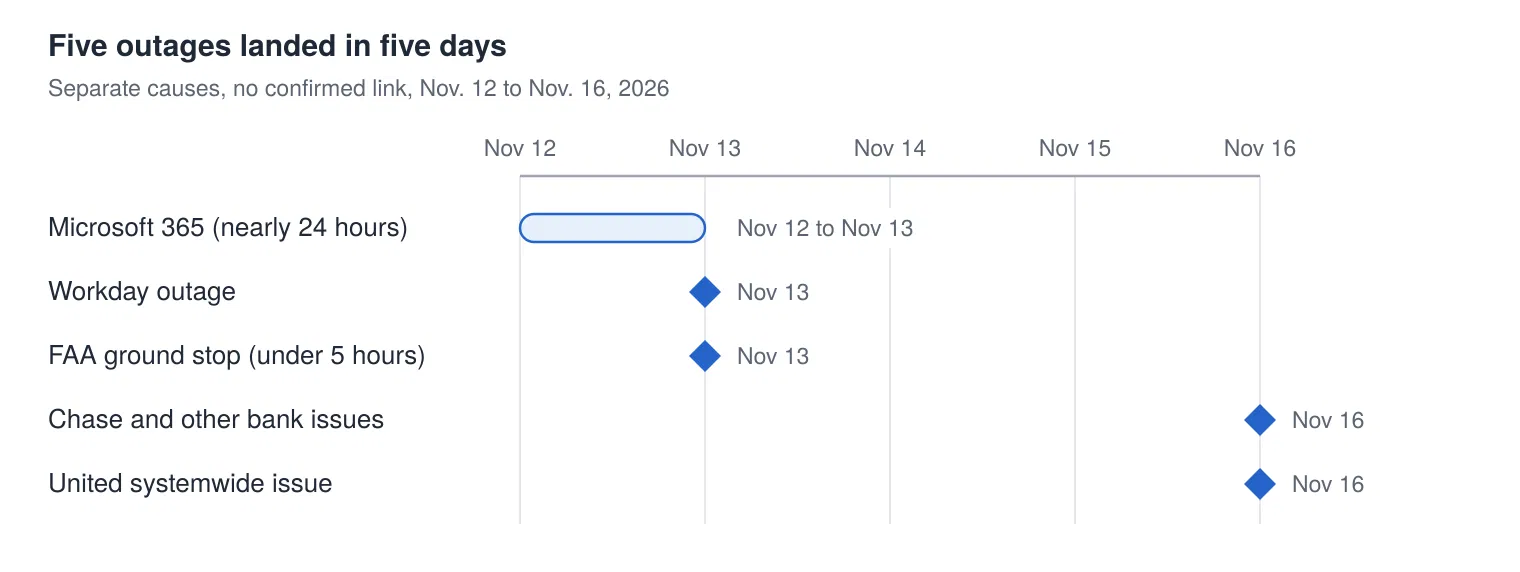
The timeline shows when each outage hit. The details behind each marker follow, based on what has been reported so far.
- Microsoft 365 (Thursday, Nov. 12). Outlook, Exchange Online, Teams, Copilot and other services were disrupted for nearly 24 hours, with email hit hardest. Microsoft’s preliminary account points to a previously undetected software defect combined with heavier traffic and reduced server capacity.
- Workday (Friday, Nov. 13). The HR and payroll platform, which serves roughly 11,500 companies, suffered a widespread outage. Not every customer reported problems.
- FAA ground stop (Friday, Nov. 13). From about 3:30 p.m. to 8:15 p.m. Eastern, departures were halted nationwide. The FAA reports instability at 17 of 22 en route control centers, says every aircraft landed safely, and counts roughly 12,462 cancelled flights that day, not all directly caused by the ground stop. Recovery stretched into the weekend.
- Banks (Monday, Nov. 16). Chase attributed slowed transactions to a software bug, not a cyber issue, and said it was not systemic. Customers of Wells Fargo, Bank of America, U.S. Bank and Truist also reported problems on outage trackers, though causes and scale there were unclear, and some reports said Bank of America and Citi were unaffected.
- United Airlines (Monday, Nov. 16). A systemwide technology issue delayed departures and was resolved the same afternoon.
One caution: outage trackers count user reports, not affected customers. They are a smoke detector, not a measuring tape.
🔍 Was This a “Stress Test”?
It’s a useful phrase, so let’s be precise about it. Nothing in the public record suggests these events were connected, coordinated or malicious. Microsoft, the FAA and Chase each point to internal technical causes; the FAA says it has no indication of a cyberattack, and Chase says its issue is not systemic. Treating a coincidence of timing as a conspiracy would be a mistake.
But a stress test doesn’t need a villain. It only needs pressure applied so we can see where a system bends. Five patterns stood out:
Pattern 1: Change is the most dangerous moment. The FAA traced the trouble to data flooding its network from two possible sites, one where a contractor was deploying a new router, and says it will reevaluate when such work is scheduled. At Microsoft, a flaw sat dormant until unusual conditions lined up. Systems tend to fail while being updated, not while running.
Pattern 2: Old meets new. The FAA attributes the instability to legacy equipment during a long move away from copper-wire infrastructure. Modernization is necessary, and the seam between old and new is where risk concentrates.
Pattern 3: Failover can spread a problem. Analyses of Microsoft’s status updates describe servers dropping out and shifting load onto those that remained, until those were overwhelmed too. A backup plan never tested under real load is a hope, not a plan.
Pattern 4: Dependencies stay invisible until they fail. Dana never chose the gateway, the contractor or the settlement step her week depended on. Chase noted that other banks transacting with it could feel its slowdown. That spillover is a textbook dependency cascade, and exactly the kind of third-party chain contingent business interruption coverage is meant to address, depending on policy wording.
Pattern 5: Safety systems held. The FAA says every aircraft landed safely. Chase says customers kept access to their money. Slow and painful is very different from catastrophic, and the people who kept it that way deserve credit.
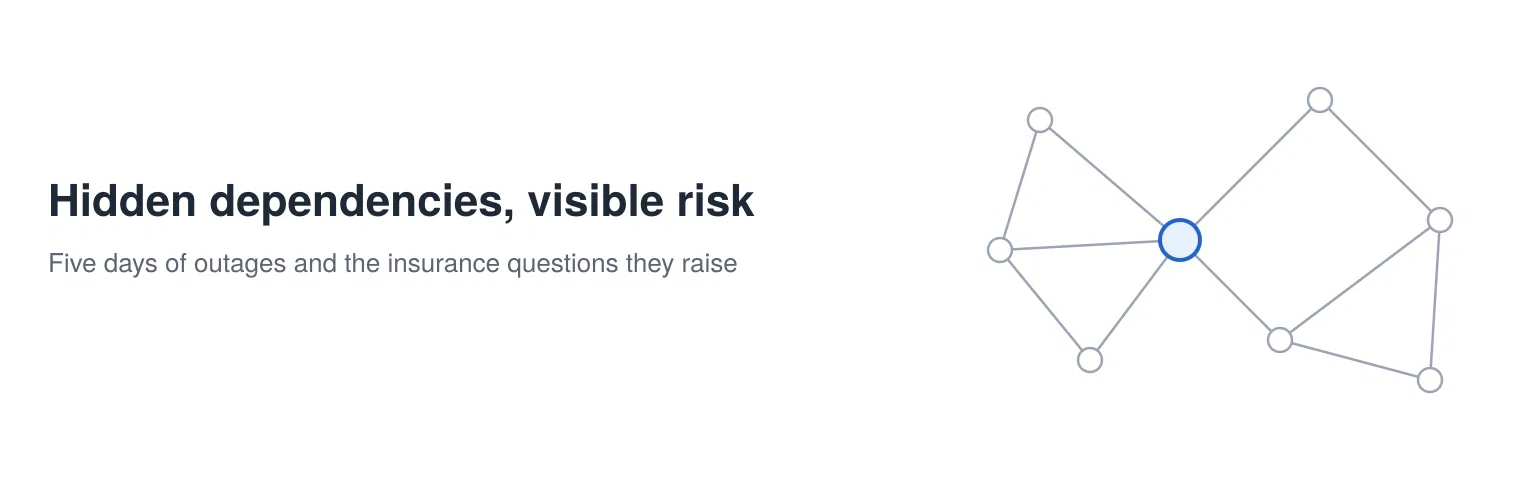
Those five patterns are easier to see on a map. The diagram below traces Dana’s week through the providers she relies on, and through the systems those providers rely on in turn.
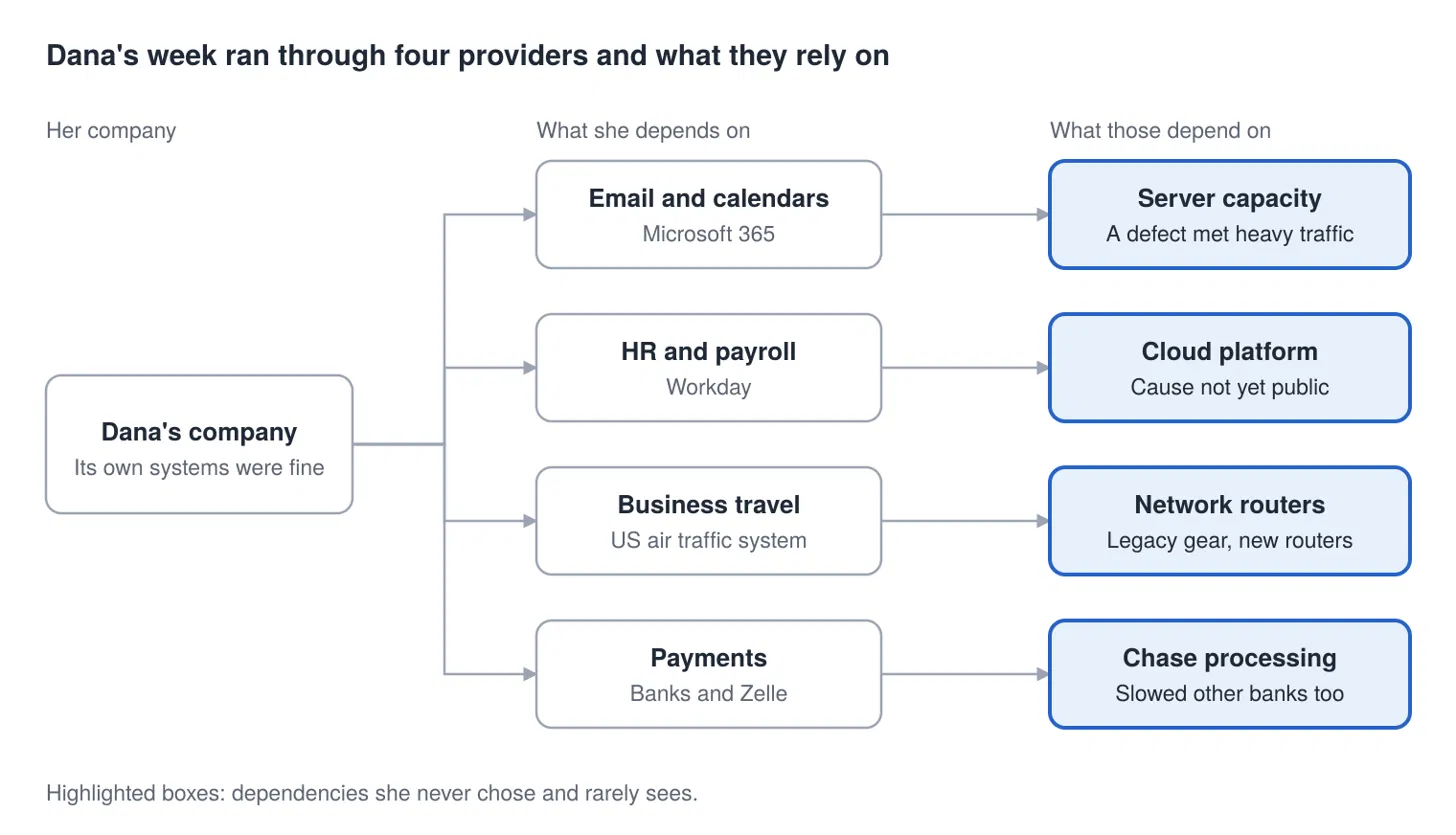
The lesson isn’t that the sky is falling. It’s that a failure doesn’t have to be an attack to be expensive.
🛡️ Where Insurance Enters the Story
The question we hear most after a week like this: “Would our insurance have covered it?” The honest answer is that it depends on the wording, the cause, the duration, and the vendor. Eight concepts decide the outcome. For a closer look at one of these events, see our companion piece, When the Skies Stop: The Business Interruption Risks Behind America’s Aviation System.
1. Business interruption (BI) versus contingent business interruption (CBI). BI generally responds when your own systems go down. CBI, also called dependent business interruption, responds when a third party you rely on goes down and stops you from operating. Dana’s own systems were fine, so only CBI speaks to her week, and it is not in every policy.
2. Malicious versus non-malicious triggers. Many cyber policies were built with attacks in mind. If a policy covers only malicious events, or doesn’t clearly include system failure, “no cyberattack” can mean “no coverage.” Read the trigger language closely.
3. The waiting period. Coverage often begins only after an outage has lasted a set time, commonly 8 to 12 hours, with shorter and longer options. A nearly 24-hour email outage may clear that bar. A ground stop of under five hours may not, though the cancellations that followed ran longer. How a policy measures the clock matters.
4. Named versus unnamed providers. Some CBI coverage applies only to vendors listed on the policy, others to any dependent provider. Ask whether a government agency, or a contractor working for one, would qualify at all. Do not assume.
5. Retentions, sublimits and vendor promises. Deductibles, per-event limits and system-failure sublimits can shrink recoveries, and a vendor’s service credits rarely approach the cost of a lost day.
6. Aggregation: one event, many victims. After the July 2024 CrowdStrike outage, Parametrix estimated about $5.4 billion in direct losses for affected Fortune 500 companies, with an estimated 10% to 20% insured, while CyberCube put insured losses at $400 million to $1.5 billion. Reinsurers have since scrutinized waiting periods, critical infrastructure exclusions and event aggregation, so expect policy language to keep evolving.
7. Parametric options. Some products pay when a defined trigger is met, such as an outage of a set duration, rather than after a lengthy loss calculation. They remain a minority product and are not a substitute for traditional coverage, but they can fill gaps.
8. Adjacent lines. Large outages can also touch technology errors and omissions, directors and officers liability, and property policies. Claims rarely stay in one box.
Taken together, these eight concepts explain why two similar companies can have very different outcomes after the same outage. The difference usually lives in the policy wording, not in the headline.
Large enterprise or small business? Enterprises often face bigger limits and complex vendor webs, so program design and aggregation matter most. Smaller companies usually have fewer fallback options and thinner cash reserves, so even a one-day outage and a missing CBI endorsement can hurt. The questions are the same; the stakes feel different. Our Business and Enterprise team works with both.
✅ What to Ask Your Broker
Before your next renewal, bring these questions to your broker. They turn the concepts above into specific answers about your own policy.
- Do we have contingent business interruption coverage, and is it named-provider or any-provider?
- Does our policy cover non-malicious system failure, not just attacks?
- What is our waiting period, and when does the clock start?
- Are there sublimits or exclusions for infrastructure, utilities or government services?
- Which of our vendors are we confident would qualify as dependent providers?
- What notice and documentation does a claim require?
If your broker can’t answer one of these clearly, that is useful information in itself. Ask for the answer in writing, including how the wording would apply to a non-malicious outage at a major vendor.
🧭 What Leadership Should Do in the Next 30 Days
You don’t need to rebuild your risk program this month. You do need to ask better questions. Organizations that treat resilience and coverage clarity as a competitive advantage tend to recover faster and negotiate from strength.
- Map your dependencies. List the five to ten vendors, platforms and utilities your revenue depends on, and what they depend on. Rank them by how long you could operate without each.
- Know your numbers. Estimate what an hour, and a day, of disruption costs in each critical process. Without a number, you can’t judge whether coverage is adequate.
- Read the policy, not the summary. Confirm CBI, system-failure definitions, named providers, waiting periods, sublimits and infrastructure exclusions.
- Get claim-ready. Keep timestamps, incident logs, vendor notices, and records of extra expenses and lost sales from the first hour. Many policies require prompt notice.
- Test the fallback. Run a tabletop: email, payroll and payments are down for 24 hours. Who decides what, and how do you reach customers?
- Review contracts and brief the board. Check service levels and liability limits in your largest vendor agreements, and give directors the plan, the exposure and the insured position.
None of these steps requires a large budget, only attention and a few honest conversations. Starting now means you can negotiate from clarity rather than urgency the next time the headlines turn.
🏁 The Takeaway
The past five days will fade from the headlines. The dependencies they exposed will not. The organizations that fare best next time won’t be the ones that predicted which system would fail. They will be the ones that knew what they depended on, rehearsed a plan, and understood before the call came exactly what their insurance would and would not do.
As an independent agency, we compare carriers and policy language on your behalf. Schedule a short coverage review focused on system-failure and contingent business interruption wording, or explore our cyber, property and enterprise coverage options and more insights on the PolicyAdvantage blog.
This article is for general information only and is not legal, financial or insurance advice. Coverage depends on specific policy wording and the facts of each loss. Details of the November 2026 events come from public reporting and official statements and may change as investigations continue.
_______________________________________________________
📚 Sources
The reporting and analysis below informed this article. Official statements are listed first wherever they were available.
- FAA: Nationwide Ground Stop Questions and Answers (official statement)
- Fox News: America hits a tech wall as outages cripple email, ground flights and disrupt major banks
- Associated Press via WSMV: Technical issue triggers online banking delays across major US banks
- KCRA/Hearst: Customers at major US banks report difficulty with some online services
- Detroit News: Major U.S. banks face widespread service outages
- ABC7: United Airlines outage and FAA live updates
- Cybersecurity News: Massive Microsoft 365 outage (quoting Microsoft’s status posts)
- Control Plane: What Caused the Microsoft 365 Outage of November 12, 2026 (analysis of Microsoft status updates)
- Insurance Journal: Insured losses from CrowdStrike outage could reach $1.5B, CyberCube says
- Cybersecurity Dive: CrowdStrike outage cost to the Fortune 500
- Lockton: Recent outages shine spotlight on systemic cyber risks
- Olshan: Microsoft Outage Highlights the Need for Robust Review of Cyber BI and CBI Insurance Coverage
Several of these events were still developing as of November 17, so details may change. Check the original sources for the latest information as investigations conclude.